Direct sales in mobile games: is the app store commission era ending?
An Oct 22 ruling in Australia forces Apple to open iOS to rival stores and payments. What direct-to-consumer sales mean for mobile game developers.
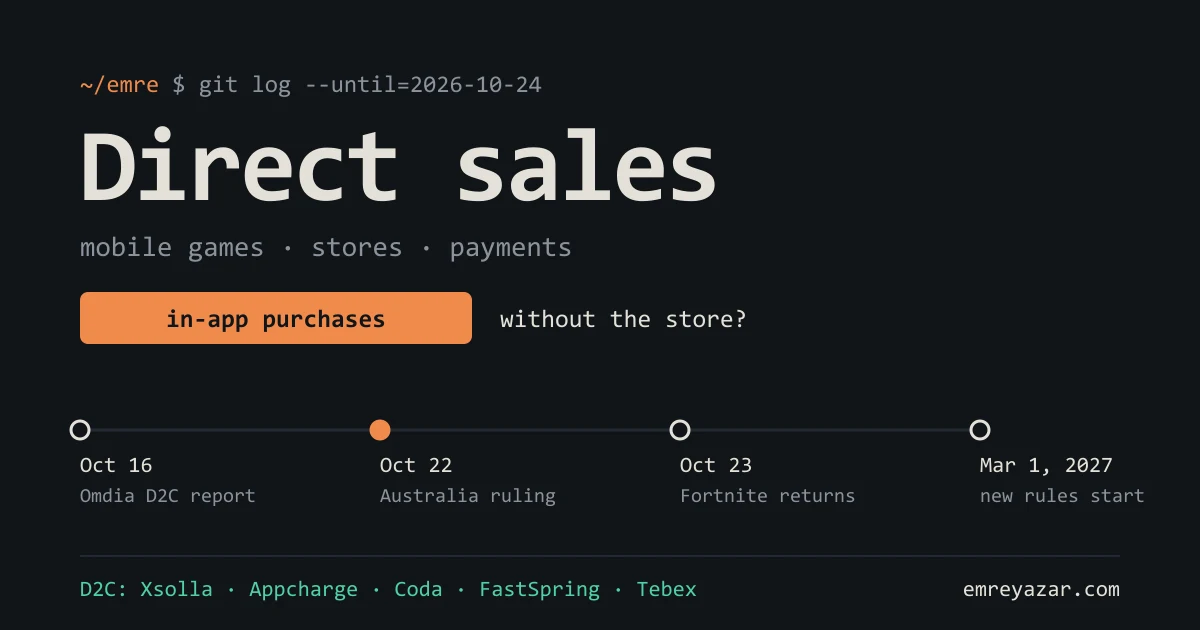
Two stories in mobile gaming fit together neatly this week. On October 22, a court in Australia ruled that Apple has to open the iPhone to rival app stores and payment methods. The next day, Fortnite returned to the Australian App Store. A week earlier, research firm Omdia had reported that mobile game developers are increasingly selling direct, without the app store in the middle.
As someone who makes mobile games too (Catchyard and Varoluş), I read all of this closely. This post covers what changed, what didn’t, and how a small game developer might think about it.
At a glance
- Direct-to-consumer (D2C): players buy in-game currency, items or subscriptions through the game company’s own web store or payment system instead of App Store or Google Play billing.
- Oct 22, Australia: the court ordered Apple to allow rival app stores, direct downloads and alternative payments in Australia from March 1, 2027. Apple says it will appeal.
- Oct 16, Omdia: D2C platforms are growing. Leaders include Xsolla, Appcharge, Coda, FastSpring and Tebex.
- Outside Australia: the ruling only covers Australian users. Elsewhere, nothing changes yet.
What happened in Australia?
Epic Games is behind the case. Epic has been fighting Apple for years over in-app purchase commissions and the App Store being the only way in. It brought the same fight to Australia, where the court found in August 2025 that Apple had misused its market power. The October 22 decision was the second step: how to fix it.
As Fone Arena reports, Justice Beach’s orders require Apple to allow, in Australia:
- distribution of apps through rival app marketplaces;
- direct downloads from developers’ own sites;
- alternative payment systems, without also having to offer Apple’s in-app purchase;
- developers pointing users outside the app to complete a purchase.
According to Epic, Apple will also be barred from charging fees on purchases made through third-party stores. The rules take effect on March 1, 2027 and apply to users whose Apple Account region is Australia. Apple says it disagrees with the findings and will seek a stay and appeal.
Security isn’t thrown out, either. The court prohibits disproportionate barriers to alternative channels but lets legitimate security checks and review requirements stay. I think that’s an important detail: the door opens, but there’s still someone checking IDs at it.
Why does Fortnite’s return matter?
Fortnite was pulled from the App Store during the Apple–Epic fight. Over the past months it had returned almost everywhere; Australia was the last market waiting on a court decision. It came back on October 23, the day after the ruling.
For game developers it’s a symbolic moment. One of the biggest games in the world comes back saying, in effect, “I challenged the store’s rules and won.” That makes it easier for large studios to push harder on direct sales.
Why is direct selling growing?
When App Store or Google Play handles payment, a significant share of each sale goes to the store as commission. With direct sales, payment runs through the game company’s own channel. According to the Omdia report covered by Cyprus Mail, as regulatory changes make this easier, mobile developers are increasingly selling in-game items, virtual currency and other digital content directly.
A whole sector has grown around it. Omdia’s leaders are Xsolla, Appcharge, Coda, FastSpring and Tebex. These companies can act as the merchant of record (taking on tax and invoicing), process payments, run a branded web store for the game and provide sales analytics.
Omdia sees two gains from selling direct: better margins and a more direct relationship with players. The report also comes with two warnings: the market is closely contested, with a narrow gap between leaders and challengers, and many features are new, so today’s leader may not be tomorrow’s.
What changes for a small game developer?
The first reaction to this news might be “I’ll open my own store right away.” I don’t think it’s that simple. Selling direct saves on commission, but it also hands back work the store does for you today:
- Payments and tax: different taxes, invoices and refunds in different countries. That’s why D2C platforms exist, and they take a cut too.
- Fraud and refund requests: the store handles most of this today. Selling direct, it’s on you.
- Friction for the player: one-tap purchases inside the game are a habit. Sending a player to a web page and asking for card details can lose some of them.
- Rules that change by country: the Australian ruling only covers Australia, and Apple is appealing. Every country has its own rules and its own timeline.
My takeaway: for big games, direct sales are already a serious revenue line. For a small studio, the real win for now is that the option exists. Designing your game so it could move to direct sales later, by not tying your purchase flow tightly to a single payment system, is the smartest preparation you can do today.
If you’re outside Australia
Short answer: nothing changes yet. The ruling only covers users whose Apple Account region is Australia. A player elsewhere keeps buying through the App Store as before.
But the direction is clear. Similar steps have been taken elsewhere, such as the EU’s Digital Markets Act and Epic’s case in the US. Each new market moves us a little closer to the end of the era when the app store was the only door. For studios selling to players around the world, keeping track of these rules is now part of the job.
FAQ
What is direct-to-consumer (D2C) in mobile games?
It’s when players buy in-game currency, items or subscriptions through the game company’s own store or payment system instead of App Store or Google Play billing. The goal is to reduce store commission and build a direct relationship with players.
What does the Australian ruling change?
Under the October 22, 2026 ruling, Apple must allow rival app stores, direct downloads and alternative payments in Australia from March 1, 2027. Apple has said it will appeal.
Does the ruling affect players outside Australia?
No. It only covers users whose Apple Account region is Australia.
Which companies provide D2C services?
Omdia’s 2026 report names Xsolla, Appcharge, Coda, FastSpring and Tebex as leaders, with Aghanim and Neon also noted as strong options.
Sources
- Fone Arena: Apple ordered to allow third-party app stores in Australia from March 2027
- ACS Information Age: Apple ordered to allow third-party app stores in Australia
- NewsBytes: Fortnite finally returns to Australian App Store after court ruling
- Cyprus Mail: Mobile game developers embrace direct-to-consumer sales