AI made writing code faster. So where is the time going?
GPT-6.1 Terra launched Oct 27, Microsoft open-sourced Scope to test coding agents, and Atlassian's survey shows AI time savings shrinking. What's changing?
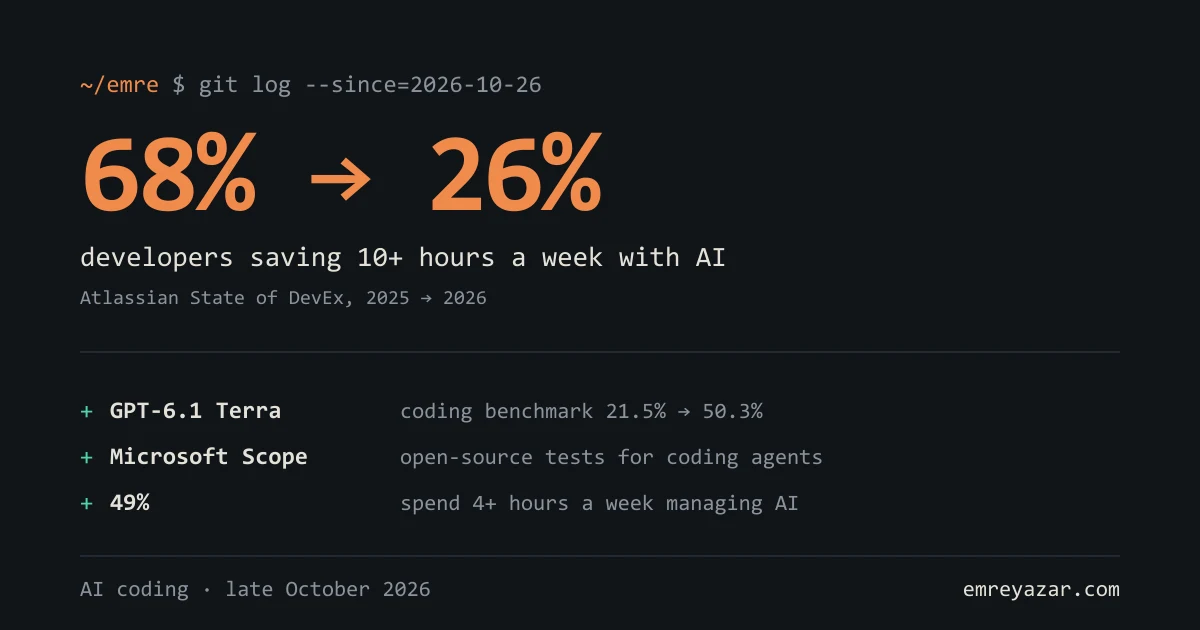
The last week of October was a busy one for AI-assisted software development. On October 27, OpenAI released GPT-6.1 Terra, a model that more than doubles its predecessor’s coding score at half the price. Microsoft’s Scope, an open-source tool for testing AI coding agents, made the rounds. And the results of Atlassian’s annual developer survey started circulating.
The first two stories say “faster and cheaper.” The third says something else: the share of developers who say AI saves them more than 10 hours a week fell from 68% to 26% in a year.
I’ve put the three stories side by side here, because I think the real story is in the gap between them. Writing code got faster, but the time is going somewhere else.
At a glance
- GPT-6.1 Terra (Oct 27): OpenAI’s new model for computer use and coding. Its coding benchmark score went from 21.5% to 50.3%, and the price was cut in half.
- Microsoft Scope: a free, open-source tool that measures how well AI coding agents work with a piece of software.
- Atlassian 2026 report: 95% of developers use AI. But fewer report big time savings, and about half spend 4+ hours a week managing AI’s work.
- The common thread: writing code got easy. The hard part now is checking it, verifying it and taking responsibility for it.
GPT-6.1 Terra: faster, cheaper, more capable
According to OpenAI, Terra is a model that can operate software on a computer and get work done. OpenAI’s example is a mundane one: reading incoming invoices and entering the details into accounting software.
The part developers care about is the code. As Help Net Security reports, on Terminal-Bench 4.0, which gives real command-line tasks, Terra solves 50.3% of tasks at its highest reasoning setting. The published figure for the previous version, GPT-5.6 Terra, was 21.5%. And it costs half as much.
Two caveats. Most of these numbers come from OpenAI’s own testing, and independent evaluations are still thin. And even at its best setting it leaves about half the tasks unsolved; OpenAI itself recommends other models for the most complex coding work.
There’s one more detail, and to me it’s the most important. OpenAI says Terra reaches the “Critical” level for cybersecurity on its own risk framework. That level means an AI capable enough to find vulnerabilities in real systems and build working exploits for them. OpenAI says it shipped the model with additional safeguards for that reason. The story in my previous PHP2Shell post is what this looks like in practice: teams working with AI found a bug nobody had seen for years, and attackers were on it within hours.
Microsoft Scope: how does AI use your software?
The second story got less attention, but it matters to anyone building software products. Microsoft’s Scope gives AI coding agents realistic tasks involving a piece of software, records what they do and scores the result.
If you’re not a developer, here’s the idea. Libraries and services used to be used by people: people read the docs and copied the examples. Now AI agents do part of that work. A service can be perfectly clear to a human and still lead an agent to the wrong method, or leave it stuck. Scope exists to measure that gap.
Microsoft’s own example is concrete. The Azure Cosmos DB team used Scope and, based on where agents got stuck, fixed 20 tooling issues and 27 documentation issues. After one targeted update, the rate at which agents used the recommended approach went from 47% to 100% in the tested scenarios.
I think the idea matters more than the tool: we’re no longer designing products only for people, but also for the AI that will use them. A product with clear docs and correct examples is a product the agent uses correctly, too.
The Atlassian report: code got faster, time went elsewhere
The third story tempers the excitement of the first two. Atlassian’s State of Developer Experience 2026 surveyed 1,155 developers and 405 engineering leaders. Per InfoQ’s summary, the standout numbers are:
- 95% of developers say their organization actively uses AI.
- 87% say AI helps them ship faster.
- But those saving more than 10 hours a week fell from 68% to 26% in a year.
- 49% spend more than 4 hours a week managing AI tools.
- 65% lose time correcting AI output that missed the original intent.
- Only 28% say their work has noticeably less friction than before AI.
Atlassian’s CTO for AI put it well in the report: the bottleneck has moved to managing AI’s work.
Two things to keep in mind. These are self-reported perceptions, not measurements. And the report comes from a company that sells developer tools. Still, the direction is consistent, and familiar.
One more number stood out. When developers were asked where their time goes, the top answers were finding information, meetings, context switching and technical debt. Writing code wasn’t on the list at all. In other words, AI is speeding up the part that wasn’t the bottleneck.
What the three stories say together
Writing code got cheap. Terra’s price halved and its score doubled. The next model will probably be cheaper still.
What didn’t get cheaper is being sure the code is right. Someone has to read it, check it does what was asked, make sure it’s safe and own it once it ships. The “4 hours a week” in Atlassian’s report is exactly that work. Microsoft’s Scope is, at heart, chasing the same question: how do we measure whether the AI’s work is any good?
Security points to the same place. If models like Terra have reached a “Critical” level at finding and exploiting bugs, every line that ships without review carries more risk. Code written fast but never reviewed can become a bug that’s found just as fast.
What it means to me as a product owner
Masada, Ne Zaman and Kısacık are used by real businesses every day. For a café using Masada, the cost of a bug is a menu that won’t load during the lunch rush. That’s why, to me, the real question isn’t “how fast can I write code” but “how do I know what ships actually works.”
This week’s news made that question feel bigger. If AI speeds up writing code, I think the smartest investment is to spend part of the time saved on review, tests and security checks. Speed isn’t a gain by itself; it’s only a gain once it turns into a product that works.
A note for business owners too: if a developer or agency tells you “we’ll do it faster and cheaper with AI,” ask one more question: “Who checks what gets written, and how?” If there’s a clear answer, the speed will genuinely work for you.
FAQ
What is GPT-6.1 Terra?
An AI model OpenAI released on October 27, 2026 that can operate software on a computer and write code. According to OpenAI, it more than doubles its predecessor’s coding benchmark score at half the price.
What does Microsoft Scope do?
It’s an open-source tool that measures how correctly AI coding agents use a piece of software, its docs or its services. It’s built mainly for teams that make libraries, services or developer tools.
Does AI really save developers time?
According to Atlassian’s 2026 report, most developers feel faster. But those reporting big time savings fell from 68% to 26%, and about half spend more than 4 hours a week managing AI’s work.
Is AI-written code safe?
It’s neither safe nor unsafe by default. What matters is that a person reviews and tests it before it ships, regardless of who or what wrote it.
Sources
- OpenAI: Introducing GPT-6.1 Terra
- Help Net Security: GPT-6.1 Terra meets OpenAI’s Critical cyber threshold
- Microsoft Open Source: Introducing Scope
- Atlassian: State of Developer Experience Report 2026
- InfoQ: Developers reporting double-digit weekly time savings from AI fell from 68% to 26%
- SD Times: Developers report mixed feelings as AI adoption hits record highs